


 get quote
 schedule a call
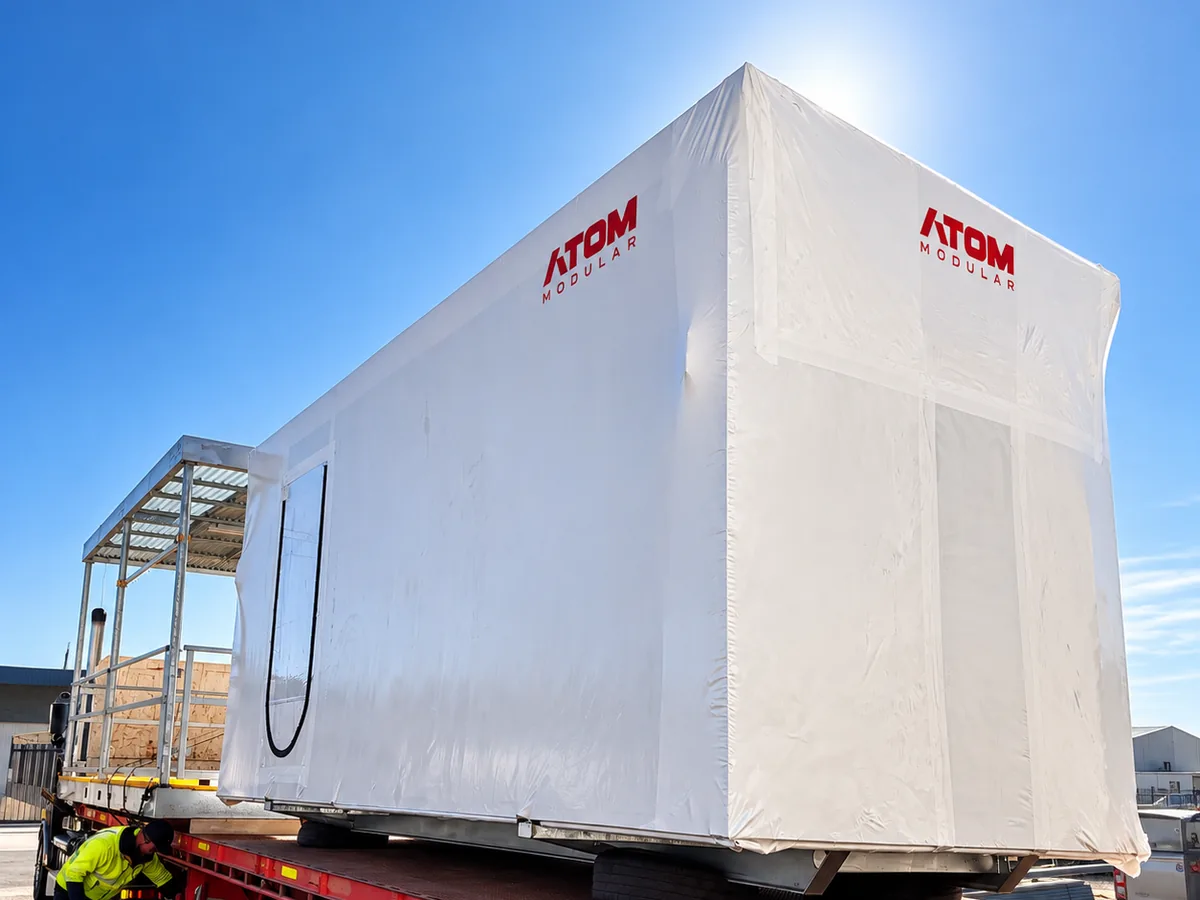
Your modular building leaves the factory clean. The road to your site can change that.
Dust, rain and road grime can leave you with cleaning to organise when the building arrives. Shrink wrapping adds a protective barrier before transport, helping reduce that exposure.
Wrapping protects the building during the journey. Post-delivery cleaning removes dirt after it arrives.
ATOM Modular offers transport shrink wrapping as an additional service.
What is transport shrink wrapping?
Transport shrink wrapping uses industrial film fitted around the building or selected areas requiring protection. Heat shrinks the film into a close-fitting covering, with joins sealed to form a temporary barrier.
Correctly installed wrapping helps protect covered areas from dust, rain and road grime during transport. Its tight fit also limits the loose material that can flap in the wind.
The extent of coverage matters. Confirm which surfaces and openings will be protected before comparing wrapping with cleaning.
Wrapping vs post-delivery cleaning at a glance
| Consideration | Transport shrink wrapping | Post-delivery cleaning |
|---|---|---|
| Main purpose | Limit exposure during transport | Remove contamination after arrival |
| When the work happens | Before dispatch, with removal coordinated at the destination | After delivery |
| Dust and road grime | Helps keep contamination off covered areas | Removes accessible dirt once it has settled |
| Rain exposure | Adds a temporary weather barrier over covered areas | Cleaning cannot prevent water entering during transport |
| Site requirements | Removal and waste handling need planning | Cleaners, access and suitable cleaning resources need planning |
| Added cost | Film, application, removal and disposal arrangements | Cleaning labour, equipment, access and any return visits |
| Main limitation | Protection depends on coverage, installation and the wrap remaining intact | Cleaning deals with the result of exposure; it does not prevent it |
What are the benefits of wrapping before transport?
Less transport contamination to clean off
A protective covering helps keep dust and road grime away from the surfaces beneath it.
For your project team, that can mean less transport-related cleaning to arrange at the destination. It is particularly useful when organising cleaners at site would be difficult.
Wrapping does not remove the need for all cleaning. Unwrapping, installation and other site work can still leave surfaces needing attention.
Protection during the journey
Cleaning is useful for dirt that can be removed. It cannot prevent exposure while the building is travelling.
That distinction matters where a module has openings or areas requiring temporary protection. A clean after delivery cannot undo every consequence of rain or contamination entering an exposed area.
Wrapping should be considered as part of the transport-protection scope, rather than simply an alternative cleaning method.
More preparation completed before dispatch
Site teams already have delivery, unloading and installation to coordinate.
Selecting wrapping puts part of the preparation before the journey. You can agree on coverage, removal and responsibilities while planning the delivery, instead of deciding how to tackle transport grime after arrival.
The benefit is one less thing to handle when the buildings arrive on-site.
When might post-delivery cleaning be enough?
Wrapping is an additional cost. It will not be necessary for every delivery.
Cleaning alone may be a reasonable choice where:
- The building is enclosed, with no exposed areas requiring temporary weather protection.
- The route and expected conditions present limited contamination risk.
- Suitable cleaning services and resources are readily available at the destination.
- Cleaning can fit into the installation programme without creating a problem.
A shorter trip may support that decision, but distance alone should not determine it. Consider the building’s configuration, weather exposure and destination as well.
The question is whether you need protection during transport, a clean after delivery, or both.
When is wrapping worth considering?
Wrapping deserves closer consideration when:
- The journey involves extended exposure to road grime or dusty conditions.
- Modules have open faces or other areas needing temporary protection.
- The destination is remote and cleaning resources are difficult to arrange.
- Your team wants to limit the amount of transport-related cleaning required at site.
For example, a fully enclosed building travelling a short distance to a well-resourced site may only need cleaning. A module with exposed areas travelling to a remote location presents a different decision.
Is wrapping cheaper than cleaning after delivery?
There is no reliable blanket answer. The comparison depends on the number of buildings, the journey, and the work required at the destination.
Ask for a project-specific wrapping price. Confirm the coverage and whether removal and waste handling are included.
Then compare it with the full cleaning arrangement:
- Labour and travel to site.
- Equipment, water and power requirements.
- Access to the surfaces needing cleaning.
- Timing around unloading and installation.
- Any additional visits required.
Wrapping may be worthwhile because it reduces exposure, even where its quoted price exceeds a basic clean. Equally, cleaning may be sufficient where transport risk is limited and site access is straightforward.
Neither option should be described as cheaper without comparing the actual scope.
Why not use a loose tarp?
A loose tarp does not provide the same close-fitting coverage as properly installed shrink film. Material that moves in the wind can leave gaps and place strain on its fixings.
What are the limitations of shrink wrapping?
Wrapping adds material, labour and waste to the delivery process. Removal also needs to be coordinated with unloading and installation.
It is temporary protection, not a guarantee of damage-free transport. Coverage, installation quality and the condition of the film all affect its performance.
Wrapping also does not replace appropriate arrival inspections.
What should you confirm before choosing?
Before dispatch, agree on:
- The wrapping price and selected inclusions.
- Who will remove the wrapping and when.
- Who will collect and dispose of the used film.
- What inspection and cleaning will happen after delivery.
Talk to us about protection for your delivery
ATOM Modular offers shrink wrapping as an additional service for customers who want added protection during transport.
Tell us where the building is going and what access is available at site. We can work through the wrapping option alongside your delivery requirements, so you understand what is included before dispatch.
Ask about transport wrapping when requesting your modular building quote.
 Talk To The Team

